
Understanding Ashland County Released Inmates
Released does not always mean free of all custody or legal control. At the Ashland County Jail, a person may leave after bond, recognizance, dismissal, time served, sentence completion, or a community-control order. Another departure may be a transfer to the Ohio Department of Rehabilitation and Correction, another county, federal custody, or immigration custody. The public record must support the destination before an exit is called a community release.
The Ashland County Sheriff’s Office links to a Zuercher portal that defaults to current custody. A released person can drop from that default view. Yet the same portal has a Release Date filter and column, which can preserve a useful positive result for a prior booking. If the portal does not settle the question, the booking and release entry, court journal, ODRC detail, or receiving agency record becomes the better source.
Ashland County Inmate Release Types
The reason for leaving determines where an Ashland County released inmate appears next. A bond release leaves the criminal case pending. Time served or sentence completion ends the custodial part of that sentence, though supervision or another case may remain. A transfer ends Ashland jail custody without proving release into the community.
| Release or exit type | Meaning | Best next record |
|---|---|---|
| Bond or recognizance | Pretrial custody ends while the case continues. | Jail release date plus the court bond order. |
| Dismissal or court order | The court supplies authority for release. | Court journal and the jail departure entry. |
| Time served or sentence completion | The local custodial term is satisfied. | Sentencing entry and actual jail release record. |
| Community control | A court orders local supervision instead of continued confinement. | Common Pleas or Municipal Court order. |
| ODRC or agency transfer | Custody continues under another authority. | Receiving agency or ODRC offender record. |
Ashland County Release Record Fields
No single universal “release record” exists. The sheriff may hold a booking sheet, jail-system entry, release authorization, bond paperwork, property or account closing entry, and a transfer entry. Ashland’s public portal confirms fewer fields than a full records response. It shows the release date with identifying and booking context, but it does not promise an exact release time, reason, destination, or retention period.
| Field | What it can establish |
|---|---|
| Name and booking number | Ties the result to a particular jail event rather than name alone. |
| Admission or arrest date | Marks the start of that booking and helps separate repeat bookings. |
| Actual release date and time | Shows when Ashland jail custody ended; exact time may require a request. |
| Release type or authority | Explains bond, time served, dismissal, sentence completion, or another basis. |
| Receiving agency | Distinguishes transfer from community release. |
| Charges, case number, and bond | Links the jail event to the proper court docket and release authority. |
| Booking photograph | Identifies the booking event, not guilt or present custody. |
Request Ashland County Release Records
The ACSO public-records policy allows email, phone, fax, mail, and in-person requests. Its form is optional. A requester ordinarily cannot be forced to identify themselves, state a purpose, or submit in writing. A narrow request helps staff locate the existing record without asking the office to create a new report.
- Identify the person, name variants, date of birth if known, and an approximate booking or arrest date.
- Ask for the booking sheet and release or disposition entry, including actual release date and time, authority, receiving agency, charges, case numbers, bond data, and booking photo.
- Request electronic copies and an advance cost estimate. ACSO lists up to five cents per page and one dollar per CD-ROM, while email is free when possible.
- Ask the office to identify the legal basis for a redaction or withholding. Open reports can require review before release.
1205 East Main Street
Ashland, OH 44805
(419) 281-0219, Monday through Friday, 8 a.m. to 2:45 p.m.
records@ashlandcountysheriff.org
Fax: (419) 281-2060
ACSO promises prompt inspection and copies within a reasonable time, not a fixed number of days. Volume, format, storage, review, scope, identification difficulty, and operations can affect timing. For mail, the policy calls for a sufficiently stamped self-addressed envelope. Online disappearance does not establish destruction of the underlying record.
A focused request should distinguish the physical release entry from the court disposition. Ask ACSO for the booking sheet, actual departure date and time, release authority, and receiving agency. Ask the proper clerk for the journal entry that ordered bond, dismissal, community control, prison commitment, or judicial release. If the record points to ODRC, send Central Records the person’s name, ODRC number, date of birth, and relevant offense or date, then request the Release Detail or sentence-calculation entry. Keeping each request tied to an identifiable existing record reduces delay and avoids asking an office to conduct open-ended research.
Ohio Law on Ashland Release Records
Ohio Revised Code 149.43 is the public-records baseline. It calls for prompt inspection and copies within a reasonable period, subject to stated exceptions. The office may charge actual copy and delivery costs. It may also review and redact exempt material. Probation and parole proceedings, medical data, protected victim information, investigative work, and security records can receive different treatment from a basic release entry.
Ohio sealing and expungement rules appear chiefly in R.C. 2953.31 through 2953.36. Eligibility and effect depend on the case. A sealed or expunged case may vanish from ordinary public access, but that does not prove a release date or automatically erase every independently held jail or ODRC record. The actual court order and each custodian’s response control.
Ashland Bond Release Still Leaves a Case
Ashland Municipal Court publishes criminal and traffic bond information and a registered surety-agent route. Posting bond is a pretrial release mechanism. It does not establish an acquittal, dismissal, or completed sentence. A name on a surety list also does not prove that a particular person posted bond.
For an Ashland County released inmate who may have bonded out, pair the portal’s positive Release Date with the live court docket and bond order. Municipal Court handles misdemeanor, ordinance, and traffic matters. Felony matters go through Common Pleas. The jail record establishes physical departure; the court record explains the legal authority and what remains pending.
Ashland Jail Booking Numbers Explained
The sheriff’s Corrections page describes a 127-bed jail, 34 staff members, an average population of 110, and about 1,750 bookings per year. Those are current-page statements without a displayed reporting year. They provide scale, not a release count.
A booking is an admission event. One person may have more than one booking, and not every roster departure is community release. Dividing the annual booking figure into a daily release estimate would be unsupported. The Release Date filter and the booking-specific record remain the sound ways to check an individual event.
Find Released Ashland County Inmates
Start with the system that last held the person. Ashland County jail bookings, state-prison terms, federal custody, and immigration custody do not share one complete database. A no-hit in one system does not answer what another agency did.
- Open the official Ashland portal. Clear “In Custody On,” then search by name, Release Date, Arrest Date, or Held For Agency.
- Match the name, booking, arrest date, release date, charges, bond, and holding agency. Do not rely on name alone.
- If the court ordered state prison or ODRC supervision, search the ODRC record for current status, Release Detail, and supervision start.
- Check the correct court. Common Pleas covers felonies; Municipal Court covers misdemeanors, ordinances, and traffic.
- For federal or immigration custody, use BOP or ICE. If the public result stays unclear, request the actual release entry.
ODRC Search for Ashland Releases
The ODRC Offender Search applies to state-prison and Adult Parole Authority records. It does not archive every person who stayed only in Ashland County Jail. Search by name or ODRC number, then inspect the current status, Release or Parole Detail, supervision start, institution, sentence, and county fields.
| ODRC field | How to read it |
|---|---|
| Current status | “Released” or APA supervision is stronger than a projected date. |
| Expected Release Date/Parole Eligibility Date | A projected term date or parole consideration point, not proof of exit. |
| Parole or Release Detail | May state the actual release action and date. |
| Supervision Start Date | Retrospective evidence that community supervision began. |
| County of Commitment or Residential County | Helps connect a state record to Ashland, but the two fields mean different things. |
The ODRC definitions explain PRD, POA, expected dates, and statuses. A future date is not an actual discharge. When labels conflict, current status, explicit release detail, supervision start, the court journal, and ODRC Central Records form a stronger verification order.
The official ODRC search screenshot below shows the Released and APA filters that distinguish state release from county jail status.
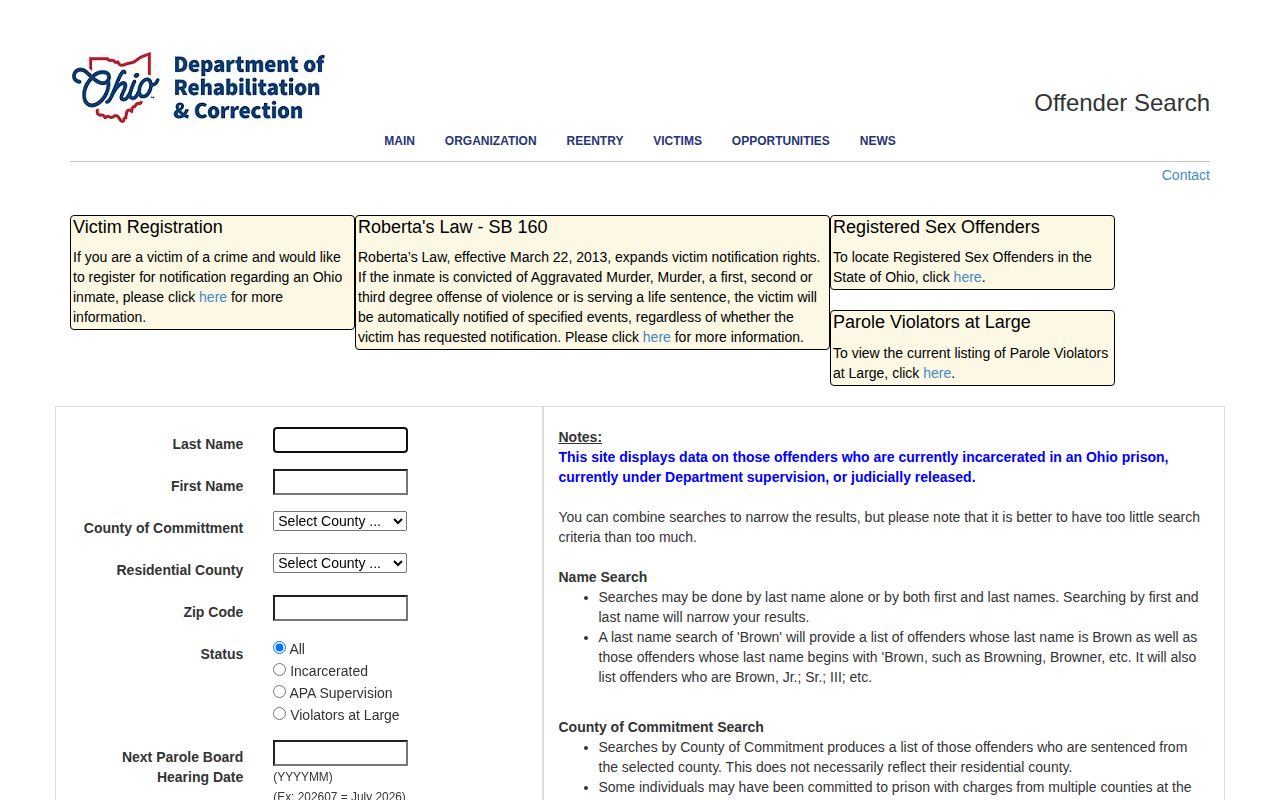
Those filters narrow ODRC records; they do not replace the sheriff portal for a person whose custody never moved into the state system.
Search Ashland County Recent Releases
Ashland has no separately branded official 24-hour or 72-hour feed. The official Zuercher portal uses calendar Release Date searches. For a 24-hour approximation, search today and yesterday. For 72 hours, search the last three dates and a fourth when the exact boundary falls there. Clear the current-custody constraint first.
The result can show a mugshot, name, arrest date, release date, held-for agency, charges, hold reason, bond form, and bond amount. It does not publish an assured retention period, exact update cadence, or public release time. Boundary cases require the release entry. The separate Ashland Jail Releases: 24 Hours treatment explains the calendar-date method.
Ashland Release Supervision Paths
Three systems serve different Ashland County released inmates. Ohio APA supervises qualifying people after state prison. Common Pleas Adult Probation handles felony community control. Municipal Court Probation handles its misdemeanor-level cases. A probationer may never have entered ODRC, while an APA supervisee can live in Ashland after a sentence from another county.
- Parole
- Conditional release from a parole-eligible prison term under APA authority.
- Post-release control
- Statutory supervision after specified prison terms.
- Probation or community control
- Court-ordered supervision that is distinct from APA parole.
- Discharge
- The formal end of custody or supervision shown by the responsible authority.
Verify APA through ODRC status and release details. Verify local probation through the sentencing or community-control journal. Office staff may limit operational details. An allegation that someone absconded is not a live location; the ODRC Violators at Large page tells the public not to approach and to contact law enforcement.
Ashland Release Planning After Jail
The Ohio Attorney General reported that Ashland received a $114,788 opioid-remediation grant in 2025. The sheriff described arranging a continuation plan before release so a person would know how, where, and when support would continue. That is a local planning practice, not a guarantee of a specific service or eligibility.
No official source in the research named a complete provider directory, transportation benefit, release exit, or standard release hour. Corrections should be asked about the specific person’s approved arrangements. The source supports the existence of coordinated planning, but it does not support invented providers or promises.
Property After an Ashland Jail Release
ACSO requires an inmate’s written direction before property can be released to a named friend or family member. At the person’s own release, the jail says remaining account funds are issued on a debit card. After a transfer, the balance goes to the receiving institution instead.
Those different money paths can help frame the right question. A debit card at exit is consistent with the jail’s community-release process, while forwarding funds is consistent with continued custody. Neither fact should replace the release record. Corrections can clarify what happened in a specific booking, subject to disclosure limits.
Ashland Courts Verify Release Authority
Ashland’s court split matters. The Common Pleas docket is the felony path. Municipal Court case access covers misdemeanors, ordinances, and traffic. Search by the case number found in the jail or ODRC record when possible, then look for bond, dismissal, sentence, jail-time credit, prison commitment, judicial release, community control, violation, or termination entries.
The Common Pleas clerk warns that online data may lag judicial action by at least 24 hours or longer. A written request or clerk visit is the verified-copy path. The court journal explains the disposition and authority. ACSO supplies the physical release date and time. One cannot reliably substitute for the other.
Ashland Release Alerts and Federal Records
Ohio VINE/VINELink can report custody events from participating county and ODRC sources and allow phone, email, SMS, or TTY notices. A released or out-of-custody result supports departure from the reporting source. It does not rule out a transfer, warrant, or another hold. Ohio warns users not to rely on VINE alone.
Federal custody uses the BOP inmate locator. A past release date and “RELEASED” mean the person is no longer in BOP custody, not that all supervision or other custody ended. ICE ODLS can cover current detention or release from ICE custody within the prior 60 days. The restricted USMS tracking system is not a public locator; use the federal docket, BOP where applicable, or a narrow records request.
BOP results update daily and cover federal inmate records from 1982 forward. A future date is projected, while “UNKNOWN” means the term is not determined in the locator. ICE searches work best with a nine-digit A-number, including leading zeroes when needed, or with exact name, birth, and country data. People under 18 are excluded, records may be withheld, and uploads can lag. After the 60-day released window, an ICE no-hit cannot prove when custody ended. Release from ICE custody may also carry reporting duties or immigration-court dates, so the person’s paperwork and assigned officer remain the sources for conditions.
Ashland Released Versus Current Custody
Choose the source by custody system and question. A live roster answers who remains held. A release record answers how and when a particular jail booking ended.
| System | Still in custody | After release |
|---|---|---|
| Ashland jail portal | Default “In Custody On” view | Release Date filter and requested release entry |
| ODRC | Institution and incarcerated status | Released, judicial release, APA status, Release Detail |
| County courts | Commitment, bond, or remand orders | Disposition, sentence completion, judicial release, supervision |
| BOP | Current federal location | Past Release Date or no longer in BOP custody |
| VINELink | Reported custody status | Reported release event, verified with source agency |
Ashland County Release Facility
Ashland County Jail is the only documented local adult detention facility in the Facility Map. It holds county and municipal arrestees under ACSO operation. Community exits may remain searchable by Release Date. Transfers must be followed through ODRC, the receiving county, a federal agency, or immigration custody.
No adult ODRC prison, federal prison, or ICE detention center was found in Ashland County. FCI Ashland is in Kentucky and must not be treated as local. Juvenile custody is outside this adult released-inmate resource.