
Ashland Projected and Actual Release Dates
A projected date estimates when custody may end under the information then in the record. An actual release date records an event that has occurred. ODRC uses the exact public label Expected Release Date/Parole Eligibility Date, and its definitions describe that value as a projected release date or a date pending parole consideration. The label therefore cannot always be read as a guaranteed prison exit.
At Ashland County Jail, the official Zuercher portal has a Release Date filter, but the public configuration does not promise a projected date. A person awaiting trial may leave after bond, recognizance, dismissal, or a new court order. Other warrants or transfers may continue custody. The correct description is often that no fixed public release date exists yet.
Find an Ashland County Projected Release
Start by identifying county jail custody versus an ODRC prison commitment. The county portal, state search, and court docket answer different parts of the question. Using all three prevents a state date from being attached to a jail-only case.
- Check the Ashland Zuercher portal for the matching booking, current custody, arrest date, held-for agency, charges, bond, and any actual Release Date.
- Read the Common Pleas docket for a felony case or Municipal Court record for a misdemeanor case. Locate the sentencing entry, jail-time credit, prison commitment, bond change, or judicial-release order.
- For an ODRC commitment, search the ODRC Offender Search by name or number and open the exact person detail.
- Record the full Expected Release Date/Parole Eligibility Date label, current status, aggregate sentence, jail-time credit, hearing data, and Parole or Release Detail.
- Near the date, verify the event through ODRC, Ashland Corrections, or the receiving agency. Do not treat a calendar estimate as proof of departure.
The Ashland County released-inmate search gives the broader confirmation route once the date has passed. Ashland Corrections is available at (419) 281-9009. A focused ACSO records request can ask for the existing release timestamp and disposition if the public page does not answer the question.
ODRC Release-Date Fields for Ashland
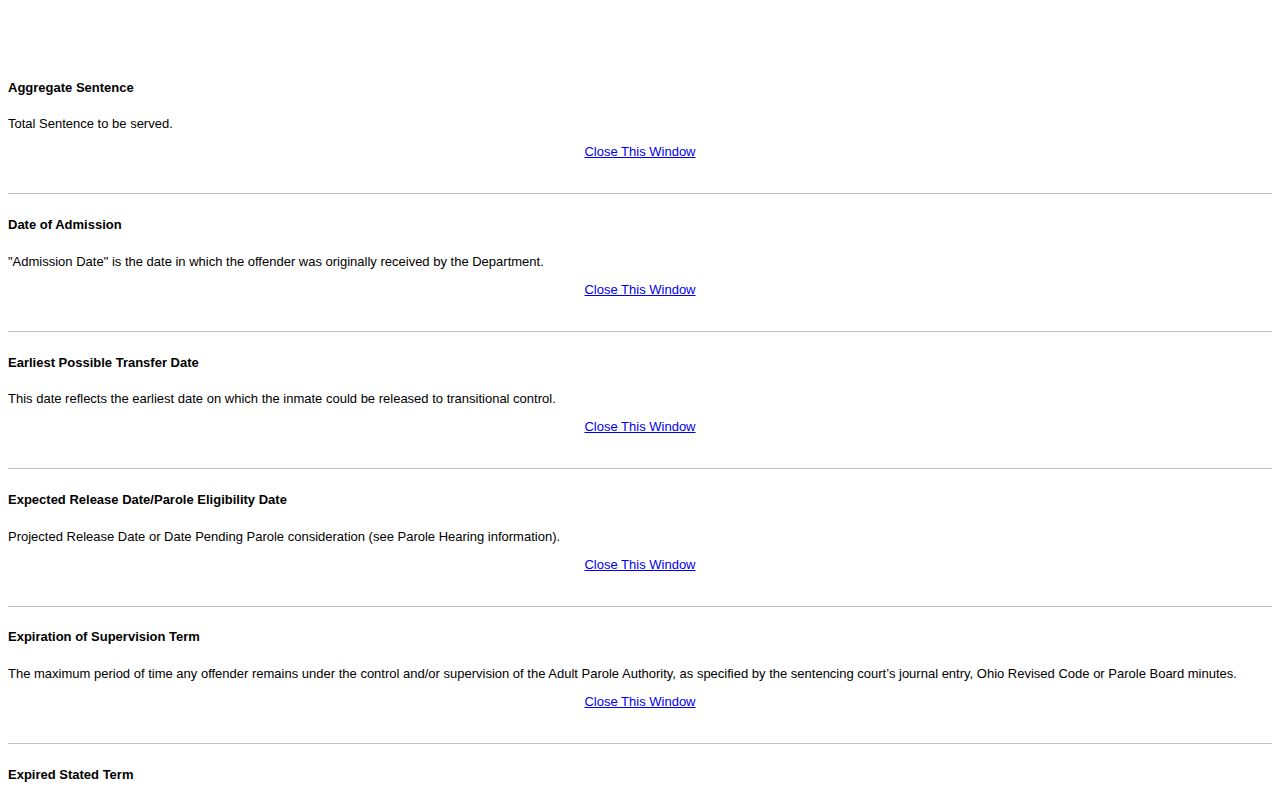
ODRC displays several date terms, and each has a narrower meaning. POA is the earliest parole-on-or-after date for release to APA supervision. PRD means projected release date. Earliest Possible Transfer Date concerns transitional control, not ordinary discharge. TC/TT Sentence Expiration is a projection tied to a halfway house. Supervision Start Date looks backward and can confirm that community supervision began.
| ODRC field | How to read it |
|---|---|
| Expected Release Date/Parole Eligibility Date | Projected term date or a pending-parole eligibility point |
| POA | Earliest parole-on-or-after date, subject to later action |
| PRD | Projected release date, not proof of an actual exit |
| Parole or Release Detail | Event and status detail that can clarify the type of release |
| Supervision Start Date | Retrospective evidence that APA supervision began |
The sentence list may be incomplete, and supervision can relate to an earlier offense. Match the ODRC number, offense, committing county, docket, and sentence entry instead of relying on a name or one date.
The official ODRC Definitions page supplies the meanings behind the abbreviated and combined date fields.
Ohio Earned Credit for Ashland Cases
Ohio has no universal rule that each prisoner leaves after serving exactly 85 percent of the announced term. For confinement on and after April 4, 2024, R.C. 2967.194 generally permits an eligible person to provisionally earn one or five days for each completed month of productive participation in qualifying programming. Up to five additional days may be available for successful completion of a second qualifying activity.
Specified diploma, equivalence, treatment, or other qualifying completion can provide 90 days or 10 percent of the stated term, whichever is less, subject to the statute. Ordinary participation and completion credits under the relevant division have a combined cap of 15 percent of the stated term. That ceiling helps explain the popular 85 percent shorthand, but credit must be earned and can be denied or withdrawn after rule violations.
Exclusions matter. The cited credits do not apply to terms made nonreducible by other statutes, death, aggravated murder or murder and specified related liability, life without parole, certain Chapter 2971 terms, and specified sexually oriented offenses. The one-day category has its own limited application. Time before the April 2024 transition may remain governed by R.C. 2967.193.
Note: Apply the current statute to the actual sentence and offense date; an interface summary cannot replace that case-specific reading.
Ashland Jail-Time Credit Changes Dates
R.C. 2967.191 requires qualifying confinement connected to the offense to reduce a prison term or affect parole eligibility as specified. The sentencing journal identifies credit, and ODRC implements the calculation under Ohio Administrative Code 5120-2-04. Counting days from an arrest page is unreliable.
Multiple cases, unrelated holds, transport, amended entries, and different confinement reasons can change what qualifies. The useful evidence chain is the sentencing journal, its jail-time-credit figure, any later correction, and the ODRC calculation. If those sources conflict, ask the Common Pleas Clerk for the certified entry and ODRC Central Records for the sentence calculation rather than creating a private count.
Central Records requests may be mailed to ODRC, P.O. Box 430, Columbus, OH 43216. Supply the person’s name, ODRC number, date of birth, and offense or date if known. A narrow request can seek the expected-date basis, jail-time credit, Parole or Release Detail, and actual release or discharge entry.
What Moves an Ashland Release Date
A public projection changes when an input changes or a later legal decision controls. Some factors shorten the expected term; others extend custody or reveal that release from one agency is only a transfer.
| Factor | Possible effect | Best record |
|---|---|---|
| Earned credit | May reduce an eligible stated term within statutory rules | ODRC calculation and R.C. 2967.194 |
| Credit denial or withdrawal | Can move a projection later after misconduct review | ODRC sentence calculation |
| Jail-time credit | Reduces qualifying time connected to the offense | Sentencing journal and ODRC calculation |
| Indefinite-term procedure | May allow continued confinement beyond a presumptive point | R.C. 2967.271 and ODRC status |
| Judicial release | A court may reduce confinement and impose community control | Court order and actual release detail |
| Parole action | A POA, continuation, denial, or rescission changes expectations | ODRC hearing result and release detail |
| Other hold or warrant | Custody may continue in another system | Held-for field and receiving-agency record |
Ashland Indefinite and Judicial Releases
R.C. 2967.271 governs qualifying non-life felony indefinite terms. A minimum or presumptive point is not always the actual exit because the statutory process can permit continued confinement. The sentencing entry and current ODRC detail are essential; a simple subtraction from the announced term misses that process.
R.C. 2929.20 governs judicial release. When granted, judicial release is a court order that reduces confinement and places the person under community control. The court can retain authority related to the reduced term. Verify the grant in the Common Pleas journal and then confirm the physical exit in ODRC release detail or supervision start. A motion alone is not a grant.
Parole eligibility under R.C. 2967.13 is also sentence and offense specific. Eligibility permits consideration, not release. ODRC’s combined Expected Release Date/Parole Eligibility Date label makes this distinction especially important for Ashland searches.
Ohio's 85 Percent Claim Explained
The local long-tail question is often phrased as whether an Ashland prisoner must serve 85 percent. The precise answer is that the current ordinary earned-credit ceiling can leave at least 85 percent of a stated term in a qualifying calculation, but the statute does not promise release at that fraction. Monthly participation, completion, caps, exclusions, and disciplinary decisions all matter.
Jail-time credit is a separate input. Judicial release is a separate court process. Indefinite sentences have their own procedure, and parole turns on eligibility and board action. These mechanisms can yield dates that do not resemble a flat percentage. The controlling sources are the sentence, current statutes, ODRC calculation, and later status.
The ODRC Definitions page explains the public fields, but the live page retains some older short earned-credit language. For time on and after the transition, the current statute controls over a simplified interface explanation.
Ashland Date Records When Sources Conflict
A public date can differ from a court entry because the sources serve different purposes and update on different schedules. The Common Pleas Clerk warns that online posting can trail judicial action by at least 24 hours and sometimes longer. ODRC performs its own sentence calculation, while the sheriff records the physical jail departure. None of those facts makes one source a substitute for the others.
For a felony prison term, first obtain the sentencing journal and any later credit or judicial-release entries. Next, compare the ODRC aggregate sentence, jail-time credit, current status, and expected-date field. If the projected figure remains unexplained, request ODRC's existing sentence calculation and release detail. For a county-jail term, ask ACSO for the admission and release timestamps and disposition rather than asking staff to create a new narrative.
A narrow public-record request is easier to identify and review. Give the name, ODRC number or booking date, date of birth if known, case number, and the exact records sought. Ask for electronic delivery and a cost estimate. Ohio's reasonable-time rule is not a fixed deadline, and neither ACSO nor ODRC should be assigned an invented turnaround.
When a transfer is involved, the Ashland release time marks departure from that jail, not freedom from all custody. Follow the held-for or receiving agency and apply that system's date fields. This distinction matters when an expected county release is followed by ODRC, federal, immigration, or another county custody.
Confirm Ashland County Actual Release
As the expected date approaches, monitor the matching ODRC status and source agency. Ohio VINE can add an alert, and the Ashland VINELink inmate-search guide explains the specific-person and notification steps. VINE is not the certified source and should not be used alone.
For Ashland County Jail, request the exact release date and time, release type or disposition, and receiving agency if transferred. For ODRC, look for Released/Discharged status, Parole or Release Detail, and Supervision Start Date. For a court-driven change, obtain the journal entry. These records distinguish an estimate from the event and a community exit from continued custody elsewhere.
Note: A projected date answers when release may occur; only a later agency record can establish when and how custody ended.