
Ashland 72 Hour Release View
There is no official Ashland County page branded as a 72-hour release list. The Ashland County Sheriff’s Office links to a Zuercher interface under “Active Inmates,” yet the same official portal offers a Release Date control. That control retrieves released bookings by calendar day. It does not measure a rolling interval from the moment the search is run.
A three-day review therefore requires several searches. Query each of the last three calendar dates and add a fourth when needed to cover the precise starting boundary. For example, a 72-hour span run late in the day reaches into part of a fourth date. The extra search will include some older results. Separate them only with the actual release time held by Corrections or shown in a release record.
Calendar dates are an approximation. The portal can identify the release day, but exact 72-hour membership requires the unshown release time.
Check Ashland 72 Hour Releases
Open the official Ashland portal and first clear “In Custody On.” That field is useful for a current roster, but it can exclude someone who left during the three-day span. Search each release date separately so results do not blur together.
- Write down the exact start and end of the 72-hour interval.
- List every calendar date touched by that span.
- Clear the current-custody date in the public portal.
- Enter the first date under Release Date and review the results.
- Repeat the search for each remaining calendar date.
- Match the booking with name, arrest date, agency, charges, bond, and photo.
- Request the timestamp for results near either boundary.
The observed interface limits the result page to 50, so a date or name filter is more reliable than assuming the screen is a complete bulk export. For today’s narrower view, use the Ashland 24-hour release page.
Ashland Three-Day Release Fields
The portal gives several matching points, but its public fields do not answer every release question. Read a result as a booking summary. A displayed date supports departure from that booking on the named day, while a source record may be needed to explain how and where custody ended.
| Displayed item | How to read it |
|---|---|
| Mugshot | An image tied to the displayed booking, if supplied. |
| Name | The booked name, which should be checked against other identifiers. |
| Arrest Date | The booking’s arrest date, not proof of a release time. |
| Release Date | The calendar day recorded for the booking’s departure. |
| Held For Agency | The agency associated with the detention or hold. |
| Charge or hold | The stated booking basis in the detail view. |
| Bond form and amount | Published bond terms, not evidence that bond was paid. |
No official source promises a public release time, exact update cadence, fixed retention period, release destination, or complete release reason in this display. The safe response is to request omitted facts, not infer them from a blank field or roster disappearance.
The official release-date interface appears below.
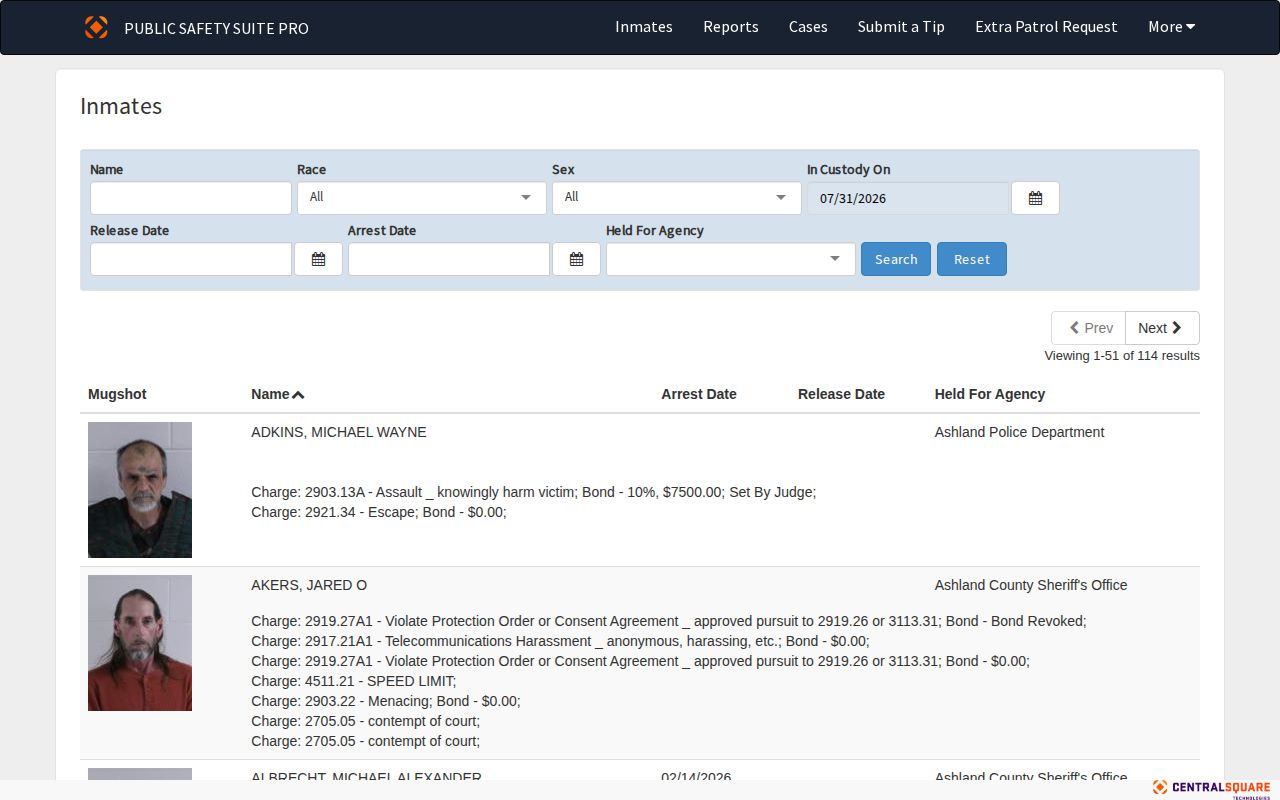
Its current-custody and release controls must be used as distinct search modes.
Ashland Weekend Release Coverage
The wider window is most useful after a weekend, holiday, or missed daily check. A search on Monday may need Friday, Saturday, Sunday, and Monday date runs depending on the hour. The portal does not publish a special weekend process or a guaranteed posting timetable, so the search should not assume every event appears at the same delay.
Court activity and physical release are also different events. A court order can authorize bond, recognizance, dismissal, time served, judicial release, or another disposition. ACSO records when the person actually leaves the jail. A docket entry may lag the action, while the public jail screen may change as operations proceed. Pair both sources when timing matters.
No research source established an Ashland weekend-release rule, release time of day, exit point, or transportation service from the jail. Those gaps must remain gaps. Contact Corrections for an operational fact rather than importing a custom from another Ohio county.
Why Ashland Release Searches Overlap
Ashland’s portal is useful precisely because its Release Date field remains available within a site introduced as an active roster. That design also causes a common search error. If “In Custody On” remains set to today, people released before the current snapshot can be screened out even though their release dates fall within the requested range.
The second issue is date overlap. Three complete calendar days are not always the same as the preceding 72 hours. Adding a fourth calendar date prevents missed boundary cases but brings in events that may be too old. Only the exact time can sort those results. Ask for the admission and release timestamps when an interval must be proven.
Finally, the public portal has no stated retention promise. A result visible now may not remain searchable for a set number of days, and no source quantifies update cadence. Record the booking identifiers and use an ACSO request for durable confirmation.
Ashland Release or Transfer
Leaving Ashland County Jail does not always mean release into the community. Bond, recognizance, dismissal, time served, the completion of a local jail term, or community control can support community release. A prison commitment sends the person to ODRC. Another county warrant, a federal hold, or an immigration hold may send the person into another custody system.
A missing name in the current roster proves none of these paths. A positive Release Date is better evidence that the booking ended, but the receiving agency or release authority determines what happened next. Use ODRC only for a person committed to the state system. Use the named county, federal, or immigration source when the record identifies that transfer.
VINELink may show a release or transfer event reported by a participating source. It is a notification layer, not a certified archive. For one named person across possible systems, the Ashland County release lookup lays out the full verification chain.
Verify Ashland 72 Hour Releases
Corrections can be reached at (419) 281-9009 for local jail confirmation. For a record, ACSO accepts email at records@ashlandcountysheriff.org, phone at (419) 281-0219, fax at (419) 281-2060, or mail and in-person requests at 1205 East Main Street, Ashland, OH 44805. Communications lists phone hours from 8 a.m. to 2:45 p.m., Monday through Friday.
Ask for a specific existing booking. Include the name, date of birth if known, and approximate booking period. Request the booking sheet, booking number, admission date and time, actual release date and time, release type or authority, receiving agency if transferred, charges and case numbers, bond form and amount, and booking photograph. Electronic delivery and an advance cost estimate can keep the request focused.
The written form is optional. Ohio and ACSO policy do not require a requester to disclose identity, explain a purpose, or put the request in writing, though voluntary details can help identify the record. ACSO states that inspection is prompt and copies arrive within a reasonable time, subject to scope, storage, format, review, operations, and the difficulty of locating the item.
Ashland Release Search Fallbacks
If the online date search yields no result, do not treat silence as proof of continued custody or release. Check spelling and date range, remove the current-custody condition, and narrow the search. Then call Corrections or request the booking and release record. A direct office response can resolve a boundary that the calendar screen cannot.
Review the correct court next. Ashland Common Pleas is the felony route, while Municipal Court case access covers misdemeanors, ordinances, and traffic cases. A court journal may explain the authority for release or transfer, but ACSO remains the source for the physical jail departure time. Common Pleas online entries can lag judicial action by at least 24 hours or longer.
Use Ohio VINE for an event alert from a participating source and ODRC’s offender search only when state-prison custody is relevant. Neither system replaces the Ashland jail release record. Together, these channels turn the three-day portal scan into a verified account without overstating what a changing public list can prove.
Keep each result in booking context. One person may have several bookings or court cases, and the same three-day scan may expose more than one event. Match the arrest date, held-for agency, charge, and case number before requesting proof. If the portal result is no longer available, those identifiers help ACSO locate the existing booking sheet and release entry. Ask the office to state the authority for any redaction or withholding. This fallback is slower than reading a date column, but it separates a true community release from a transfer and preserves the exact event after the public display changes.