
Ashland County Parole and Probation Compared
A release from Ashland County Jail does not by itself create parole, probation, or post-release control. The source of supervision depends on the sentence. A Common Pleas or Municipal Court order can impose local community control, while ODRC and its Ohio Adult Parole Authority manage parole and qualifying post-prison supervision.
| Supervision | Source and verifier | What confirms it |
|---|---|---|
| Parole | Ohio Parole Board and APA | ODRC status, parole or release detail, POA information, supervision start, and APA office |
| Post-release control | APA after a qualifying prison term | Sentencing entry plus ODRC supervision status and start date |
| Felony community control | Ashland County Common Pleas Court | Journal entry and Common Pleas adult probation confirmation |
| Misdemeanor probation | Ashland Municipal Court | Municipal docket or order and the court probation office |
Verify Ashland County Post-Release Supervision
Begin with the custody path. Someone who served only an Ashland County Jail stay will not necessarily have an ODRC record. Someone committed to state prison should be checked in the official ODRC Offender Search. The search supports APA supervision, released, judicial-release, Residential County, County of Commitment, hearing-month, and violator-at-large paths.
- Match the person by full name and ODRC number when available. Do not rely on a shared name.
- Read current status, Parole or Release Detail, supervision start, supervision duration, residential county, and the named APA office.
- For felony community control, open the Ashland Common Pleas docket and obtain the controlling journal entry if the online text is unclear.
- For misdemeanor probation, use the Municipal Court case system and confirm the order with Municipal probation.
- If a public record is incomplete, ask the office for the specific order or status record instead of requesting an entire supervision file.
The full named-person custody and release path is explained on the Ashland County released-inmate search page. That path helps establish whether the event was a county-jail release, state-prison release, or transfer before supervision is researched.
The official ODRC APA record example shows how a state detail can pair Residential County Ashland with a supervision start and named APA office.
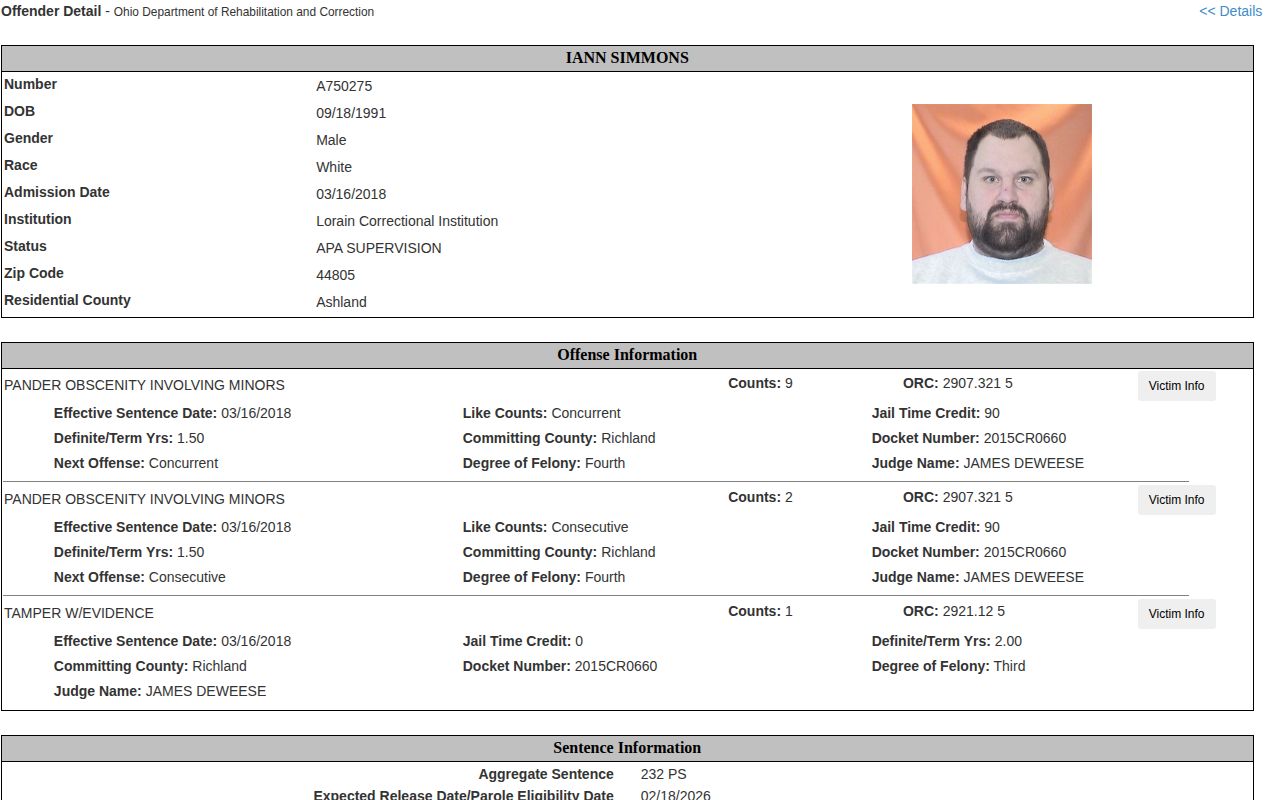
A records check should preserve the date it was made. Supervision status can change after a hearing, court entry, violation process, or discharge. Saving the docket entry number or ODRC page detail makes a later comparison clearer than a note that says only that someone was supervised.
Note: A roster disappearance proves neither community release nor supervision; pair a positive release record with the court or ODRC source.
Ashland County Supervision Offices
Ashland has three practical office routes, and they should not be collapsed into one. Common Pleas adult probation handles felony community control. Municipal probation handles qualifying Municipal Court cases. APA handles parole and post-release control tied to state custody. The ODRC person detail can name the assigned APA office, so that record is preferable to guessing an office from residence alone.
Local court supervision contacts
Common Pleas Adult Probation
142 W. 2nd St., Ashland, OH 44805
(419) 282-4355
probation@ashlandcommonpleas.com
Ashland Municipal Probation
(419) 281-2586
Monday through Friday, 8 a.m. to noon and 1 p.m. to 4 p.m.
Ohio Adult Parole Authority
Use the office shown on the matching ODRC person record. ODRC offender-search questions: (614) 752-1161.
The Common Pleas staff page identifies its adult probation contact, while the Municipal probation page describes local reporting. Staff may limit details that are not public, and Ohio public-record law excludes records pertaining to probation and parole proceedings in specified circumstances.
Ashland Probation Has Three Paths
Ashland Municipal Court publishes an unusually clear reporting distinction. Tier I uses monthly physical reporting. Tier II uses monthly telephone reporting. The court assigns the tier and may change it. Those labels apply to that Municipal probation program, not to Common Pleas community control or APA supervision.
A public docket or signed order is better evidence of probation than the fact that someone left jail. Common Pleas covers felony matters, and Municipal Court covers misdemeanors, ordinances, and traffic cases. A court disposition can establish the legal basis for community control, but the sheriff release entry establishes when the person physically left Ashland County Jail.
Ashland Parole Hearing Records
The Ohio Parole Board is part of APA within ODRC. Its practical public schedule is a person search rather than a meeting calendar. In ODRC Offender Search, enter the Next Parole Board Hearing Date as a year and month in YYYYMM format. Results identify people scheduled for that month.
ODRC explains that a case is generally reviewed about two months before a displayed future date so a hearing and decision can occur first. A past date represents the latest hearing date. The field is therefore not an actual release date. The person detail may show Latest Parole Board Hearing/Review Type & Results, the next review month, and a POA or projected release date.
Possible outcomes include a parole recommendation with a POA, continuation to a later review, Central Office Board Review, or a full-board decision. A recommendation can be rescinded before physical release, including after an institutional infraction. R.C. 2967.13 makes eligibility depend on sentence and offense, so no single eligibility formula works for all Ohio cases.
Ashland Supervision Violations and Absconders
Conditions vary by the order and supervision type. At a high level, a violation can lead to a court filing, an APA action, a warrant, a hearing, or renewed custody. It should not be inferred from a missed public update. R.C. 2967.15 addresses violations and absconding in the APA setting, while local court dockets are the practical public trail for local probation proceedings.
ODRC maintains a Parole Violators at Large listing. It can show a declared-at-large date, photograph, and offense, with a public-safety warning. A matching entry is not permission to approach the person. For an immediate safety issue, use 911 or law enforcement. The ODRC Fugitive/VAL contact is (614) 752-1114 and Fugitive.Val@odrc.state.oh.us.
Ohio VINE may send custody-event alerts, but it is not a complete public warrant index. Likewise, a court warrant and an APA declared-at-large entry are not interchangeable records. Verify the exact agency and case before describing a status.
Ashland Release Planning Continues Support
The Ohio Attorney General reported that Ashland received an opioid-remediation grant of $114,788 in 2025. The sheriff described planning before release so a person would know how, where, and when support would continue after leaving custody. This is a documented local reentry practice, not proof that every released person receives the same service.
The source does not identify every provider, eligibility rule, or appointment process. A sound inquiry asks Ashland County Jail Corrections what plan was arranged in the specific case and which organization is named in the paperwork. It should not substitute a generic provider list for the jail’s actual continuation plan.
Ashland Release Property and Funds
Ashland County Jail’s exit rules can add context to the custody event. The sheriff says an inmate who wants property released to a friend or family member must give written direction naming the recipient and the items. At the person’s own release, remaining account money is placed on a debit card. On transfer, the jail sends the balance to the receiving institution.
These rules do not establish parole or probation. They can, however, help frame a precise question about whether the recorded event was community release or continued custody elsewhere. A transfer balance and receiving institution point toward continued custody, while a release debit card fits the jail’s community-exit process. The underlying release entry remains the controlling record.
How Ashland County Supervision Ends
Release from custody and discharge from supervision happen at different times. An ODRC supervision start date shows that APA supervision began. A later discharge status or release detail is stronger evidence that it ended. For local probation, the court’s termination, satisfaction, or discharge entry is the usual public proof.
R.C. 2967.28 governs post-release control, while the sentence and applicable APA action determine its course. Public-record access does not guarantee an entire parole or probation file. Under current R.C. 149.43, supervision-related categories may be excluded or redacted even when ODRC publishes selected status fields and hearing outcomes. Ask for the least sensitive record that answers the question, such as the court termination entry or the ODRC discharge status.
A focused Ashland request can identify the person, case or ODRC number, and the termination or discharge entry sought. Ohio law generally does not let an office require a requester to disclose identity, purpose, or a written format, although voluntary detail can help staff locate the right existing record. The office may apply lawful redactions and explain withholding authority. That process is more reliable than asking staff for a broad opinion about whether supervision is over.
Note: Confirm the final status with the office that created it because public search pages can omit detail or change after review.